

 Home
 Contact me
How to learn spanish on your own
Applying the method
Do you want to learn Spanish on your own? If so, the following should be of interest to you.
On this page, I will use the method taught on this website and apply it to Spanish in order to give you an idea of how it can be used. As a result, you should be able to learn Spanish on your own.
I will also be able to teach you the language a little bit in the process because I happen to know some notions about Spanish. However, if you didn't know anything about that language, you could still get most of the information I laid out by doing a bit of research.
Here is how we'll proceed:
Be motivated
First, I will give you some practical reasons why you should learn Spanish. This should solidify your decision to learn the language.
Which variety to learn
Secondly, I will briefly discuss the several varieties of Spanish and invite you to focus on one specific variety to make the learning curve shorter. Note that you can choose to learn any variety you want and that this page is just meant to be a guide on how you can use the method.
Pronunciation
Thirdly, I will explain key aspects of the pronunciation of this variety of Spanish. I will try to outline the main difficulties of vowels and consonants and even teach you how to pronounce some of them. The goal is to shed light on what you should look for when learning Spanish.
Resources to learn it
After that, I will tell you how to find the native speakers of Spanish to practice with or, more precisely, which native speakers are more likely to give you the results you want.
Level of difficulty
Then, I will discuss the level of difficulty of Spanish. Some of the grammar rules you might have difficulties with will be explained. I chose these rules arbitrarily, but, again, since the difficulty of a language is relative, I invite you to do your own research on what native speakers of your language might find difficult in Spanish.
Learn it by immersion
Finally, I will talk about how you can use all the tools discussed in the "Creating a language immersion environment" section to learn Spanish effectively.
Motivate yourself to learn Spanish
Spanish is a very useful language to know.
It is not at the level of English, internationally, but if you're going to spend some time in Spanish-speaking parts of Latin America, you'd best be able to speak Spanish.
Unless you intend to remain in your tourist resort and to not venture out much, you will see that using English will only get you so far and sometimes, not very far at all!
And needless to say, if you intend to live in a Spanish-speaking part of Latin America, knowing how to speak Spanish is a must.
Some jobs outside of Spanish-speaking countries may also require the knowledge of Spanish due to the important quantity of speakers of this language in the world.
Which Spanish to learn?

(Countries where a significant quantity of people speak Spanish)
Here are the main categories of Spanish:
- Peninsular Spanish
- Spanish of the Americas
Peninsular Spanish is a group of varieties of Spanish spoken in the Iberian Peninsula of Spain.
Spanish of the Americas, on the other hand, is a group that encompasses all the varieties of Spanish spoken throughout Latin America.
It can be broken down further into Mexican Spanish, Cuban Spanish, Colombian Spanish, Rioplatense Spanish and so on.
I suppose that there could be other smaller categories than the two mentioned above. The variety which belongs to one of these smaller categories and which has the most speakers among them is Equatoguinean Spanish, spoken in Equatorial Guinea.
Latin American Spanish
The variety of Spanish I will teach you how to learn is Latin American Spanish.
Although each region in Latin America has its own variety of Spanish, Latin American Spanish can be seen as the "standard" in Latin America just as Castilian Spanish can be seen as the standard in the Iberian Peninsula of Spain.
Latin American Spanish is the variety that is used in most shows of major international TV channels such as The History Channel Latin America, Discovery Channel Latin America and CNN en Español.
These TV channels broadcast shows throughout Latin America, making Latin Americans familiar with this variety of Spanish.
So, knowing this variety will allow you to connect more easily with all of Latin America.
Pronouncing Latin American Spanish with phonetics
In this section, I will teach you some of the key points that will help you sound like a Spanish speaker of Latin America.
If you want to keep your accent, then you don't need to read this and you can proceed to the Resources section right away.
Before we start, it is best to be familiar with the basics of the International Phonetic Alphabet.
In case you're not, you have the opportunity to do so here.
Vowels
The vowels of Latin American Spanish should not represent too many difficulties for most of you.
Like English, Latin American Spanish has some diphthongs. Here are some examples:
E and O
One thing you should know is that the E in Latin American Spanish is a little different than you might expect.
In more accurate phonetic transcriptions, it is written as [eÌ], which lies between [e] and [É] on the vowel diagram.
You can hear it in this word:
In the "Pronouncing with phonetics" section, there is a technique you can use to learn how to pronounce [eÌ]. In order to use this technique, however, you need to take into consideration that [eÌ] is slightly more open than [e] and slightly more closed than [É].
The O in Latin American Spanish features the same kind of difference. It is noted as [oÌ] in accurate phonetic transcriptions. On the vowel diagram, this O is situated between [o] and [É]. You can also use the aforementioned technique to learn how to pronounce it.
Nasalization
Something that you might not otherwise notice while learning Latin American Spanish are the nasalized vowels (in fact, the first [eÌ] is nasalized in the previous example). In the IPA, a [Ë] is placed above the vowel that is nasalized.
Nasal vowels are not noted as such in the writing of Spanish, but every time a vowel precedes a nasal consonant such as M, N or à within a syllable, the vowel is nasalized.
Here are two examples of nasalized vowels as well as a counterexample, respectively, for contrast (note that syllables are separated by a period in these examples):
As you can see and hear, the i of pino is not nasalized even though it is preceded by nasal vowel [n]. This is because the i and the n are not in the same syllable.
Let us now say a quick word about vowel length.
Unlike English, Latin American Spanish does not have proper long vowels.
So, when you pronounce the word si in Spanish, for example, as I hear Americans do it sometimes, be careful not to make it sound like the word sea in English, which has a truly long [i:] sound.
You can hear the difference here:
In the diagram below are displayed the vowels present in Latin American Spanish (not including the nasalized vowels).
You can check these vowels against the vowels in your own native language to see how they compare:
Figure 4. Latin American Spanish vowel diagram

Consonants
Consonants in Latin American Spanish are generally much more difficult to master than the vowels.
There are many different consonants and some are not shared by most languages.
So, most likely, there will be some that are completely unknown to you. I will talk about some of the ones which I believe are not common in languages.
Also, for reasons of simplification, I avoided the use of the lowering diacritic [ Ì ], for these consonants. I shall limit myself to saying that some of the consonants of Latin American Spanish are approximants and that in more accurate phonetic transcriptions, the diacritic [ Ì ] is written below these consonants.
Spanish R
The R in Latin American Spanish can be pronounced in two different ways.
The first R is short and it is produced with a single brief burst at the alveolar ridge. It is pretty much the same as the flap in General American, found in the word ladder: [ɾ].
However, in Latin American Spanish, it is found at the endings of syllables and sometimes at the beginning.
The first word in this example shows this R at the end of a syllable and the second one shows it at the beginning.
The second R is represented by [r]. This sound is held for longer and is often referred to as the trilled R.
It is found almost only at the beginning of syllables.
This R essentially has the same point of articulation as the previously mentioned one, but instead of a single brief burst, to produce it you need to keep the air flow going and produce a continuous series of bursts.
Here are two examples of it:
Nasals and assimilation
Now, we will discuss the nasal consonants.
When M, N and à are in the initial position of a syllable, they are pronounced as [m], [n] and [ɲ], respectively.
However, they are pronounced differently when they are followed by another consonant; the nasal consonant assimilates, if you will, the characteristic of the consonant it precedes.
For example, when an N precedes a G, a G being a sound produced with the soft palate and the tongue, the N is then also pronounced with the soft palate. The resulting sound is [Å] as in king with the General American pronunciation.
As another example, when an N precedes an F, the F being produced by using the lip and the teeth, the N is then also pronounced with the lip and the teeth and the result is [ɱ], which is like an M, but you use your upper teeth instead of your upper lip to produce it.
You can observe this phenomenon here:
There are other consonants in front of which N is pronounced differently, such as V, Y and J, so pay attention to these as you learn.
V and B
Next, we will talk about the V's and B's in Latin American Spanish. When the V or B is in the initial position of a syllable, it is sometimes pronounced as a [b] as in boy.
In some words, though, instead of being pronounced as a [b], it is pronounced as a [β], which is a sound that can be described as an intermediate between [b] and [v] (note that there is no [v] sound in Spanish).
Here is how you can produce a [β]:
Start by pronouncing a continuous [v] (as in venus) and as you are doing it, notice that your upper front teeth are touching your bottom lip.
Now, slowly replace your upper front teeth with your upper lip while maintaining the "[v]" by keeping the air flowing. Both your lips should be in near contact with one another and you should now be producing a [β].
Here are some examples of that sound:
As I mentioned it in the beginning, I would not talk about all the consonant sounds in Latin American Spanish.
Below is a chart with a pretty complete list of the consonants of Latin American Spanish.
Look for the consonants that you are not familiar with and take note of the manner and point of articulation of each one. Then, I invite you to go to the page on phonetics and go check the manners and points of articulation in question in order to get an idea of how these consonants are pronounced.
Figure 5. Latin American Spanish consonants chart
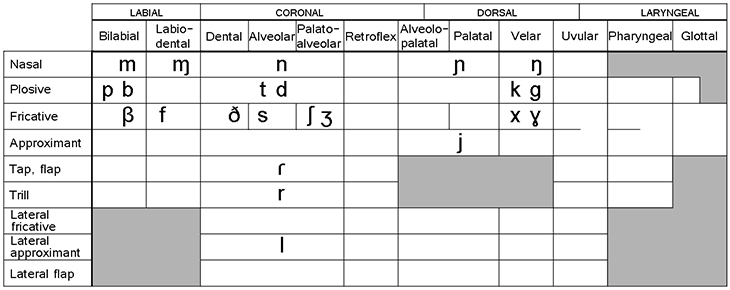
(Some of these consonants are approximants and were not noted as such for reasons of simplicity)
Tones
In order to familiarize yourself with tones, I invite you to watch TV shows where Latin American Spanish is spoken.
You could start watching these TV shows on the History Channel Latin America, Discovery Channel Latin America and CNN en Español to expose yourself to tones (and the whole language, in fact). Then, you could try to mimic them when you practice Spanish with someone.
Resources available to learn Latin American Spanish
There are a lot of Spanish speakers on language exchange websites, dating websites and in games. However, be mindful what variety of Spanish they speak.
Most of them will probably speak their own regional variety of Spanish. They may or may not try to make it a little more "standard" for you understand more easily.
In any case, ask them to try to speak as close as possible to the standard language spoken on TV shows on the channels I mentioned earlier like the History Channel and the Discovery Channel.
If they don't or can't, it's not such a bad thing; you can still get really effective practice out of speaking with them.
Besides, it can be good to expose yourself to many different varieties of Spanish spoken in the Americas since if you are going to interact with them in the future, you might want to be able to understand regional varieties.
Dating websites
When you register for an account on a dating website, usually, you are asked for your current city. In my opinion, it is best to choose an large city of Latin America (e.g. Mexico City, Panama City, MedellÃn, Lima and Santiago de Chile) to increase your chances of speaking to someone who doesn't have too much of an "accent".
Also, I would avoid the smaller websites such as datelatinamerica.com, LatamDate.com and Amor.com, because they have relatively few people on them and a lot of them are not for free.
I would stick to the bigger, more international websites such as PlentyOfFish and OkCupid.
On PlentyOfFish, when you choose your city, they might ask you for a postal code.
Now, every country in Latin America has their own system of postal codes.
I tried PlentyOfFish and I managed to select Bogotá, Colombia by putting 110111 as my postal code.
On OkCupid, they may ask you for state, province or department, so make sure you know that when you select a city. The department of Bogotá is Bogotá, Distrito Capital.
Level of difficulty of Latin American Spanish
Related languages
Spanish is an Iberian Romance language which makes it very much related to Catalan, Portuguese and Galician.
If you speak any of these languages, it will be extra easy for you to learn Spanish.
Spanish is also an Italic language. So are French, Italian and Romanian. So, if you speak any of these languages, you will have an advantage in learning Spanish that speakers of non-Italic languages will not have.
Moreover, if you speak a language belonging to the Indo-European family, this should make the learning curve slightly smoother as Spanish is also from that language family.
Complexity and features of Latin American Spanish
Latin American Spanish is moderately complex morphologically; it has a system of conjugation whereby the verb has a different form according to the grammatical person, mood and tense.
One thing you can do in Spanish which is a no-go in English is to systematically leave out the subject of the verb if it is a personal pronoun (yo/tú/él/ella/nosotros/nosotras, etc.).
This can be done because verb conjugation is much richer in Spanish than in English and the form of the verb alone is sufficient to determine what person the verb has for its subject.
So, you can say, Aprendió español as well as Ãl aprendió español which would mean the same thing if it is implied that you're talking about a man: 'He learned Spanish'.
Also, most nouns are not affected by grammatical cases in Spanish, so word order is important. Apart from verb conjugation, Spanish also features grammatical gender, two verbs "to be" (ser and estar) and lexical stress.
Verb conjugation
Spanish conjugation is quite complex, so I will outline just a few of its main aspects here. Here are the regular verb endings:
Present indicative singular endings
1st person: -o
2nd person: -s (preceded by e or a)
3rd person: -e or -a
Present indicative plural endings
1st person: -mos (preceded by e, a or i)
2nd person: -s (preceded by éi, ái or Ã)
3rd person: -n (preceded by e, a or i)
Here is what a conjugated verb looks like in the present indicative (with the personal pronoun left out):
comer 'to eat':
como 'I eat'
comes 'you eat'
come 'he/she/it eats'
comemos 'we eat'
coméis 'you eat' (plural "You")
comen 'they eat'
The same principle applies for the remainder of the conjugation; you'd best be familiar with verb endings otherwise you'll have difficulties communicating.
To learn these verb endings on your own, I suggest you don't resort to memorizing them. Instead, while you practice, try to pay special attention to them.
You might notice that verbs which have the same ending in their infinitive form also tend to have the same endings in their conjugated form. You might also see exceptions to this, so be careful.
Subjunctive
Like English, Spanish uses the subjunctive. However, compared to English, it is much more complex.
First, subjunctive verbs have their own form which brings extra conjugation to learn.
Again, let's conjugate the word comer, but instead of in the indicative present, let's conjugate it in the subjunctive present:
comer 'to eat':
coma (1st pers. sing.)
comas (2nd pers. sing.)
coma (3rd pers. sing.)
comamos (1st pers. plur.)
comáis (2nd pers. plur.)
coman (3rd pers. plur.)
Then, comes the following question:
"When do you use the subjunctive?"
In Spanish, the subjunctive is used whenever you are expressing something that does not have the element of certainty.
This can be when expressing an opinion (as opposed to a fact), when hoping for something to happen or when recommending something to someone.
There are of course other circumstances where the subjunctive is used.
So, as you practice Spanish with native speakers, try to notice when they use these special endings that indicate the subjunctive and make a mental note of which circumstance it was used in.
Grammatical gender
Unlike English, Spanish has a feature called the grammatical gender.
This means that every noun in Spanish is one of two things; masculine or feminine. This is also valid for personal pronouns and names of people.
What this involves is that adjectives associated with these nouns, personal pronouns and names have a special ending. The ending of an adjective reflects the gender possessed by the nouns, personal pronoun or name it is associated with.
Generally, masculine adjectives end with o while feminine ones end with a.
You can observe this in the two following phrases where a noun is associated with an adjective.
The noun in the first phrase is masculine (where the adjective ends with o) while in the second phrase, the noun is feminine (where the adjective ends with a):
El sombrero blanco 'The white hat'
La tequila blanca 'The white tequila'
You will also notice, during your learning, that gender also applies to verbs which act as adjectives. These verbs are usually preceded by the verb "to be").
Ser versus Estar
This for me is one of the most difficult features to master in Spanish.
Both ser and estar mean 'to be', but there's always the question of which one to use.
In order to facilitate answering this question, we can come up with a general rule that dictates when to use ser and when to use estar:
Generally, when you're talking about something that is largely permanent, you use ser and when talking about something that is a temporary state, you use estar.
Here is an example:
Hoy estoy feliz. 'I'm happy today'
Here, the verb estar (in the form of estoy) is being used since feliz (meaning 'happy') is a state of mind that is temporary in this case.
Soy de baja estatura. 'I'm short'
In this case, the verb ser (in the form of soy) is being used. I'm a short and unfortunately for me, this is not about to change.
Note that you could also say Soy feliz, which would make the word feliz have a more permanent meaning; it would mean that you are a happy person.
That being the general rule, you still need to be careful.
There are exceptions where using ser and estar can lead, not to a difference between something temporary and permanent, but to a difference in meaning.
Below is an example. In the first phrase, the verb ser (in the form of es) is used and in the second one, the verb estar (in the form of está) is used.
Este aguacate es verde.
This means that the avocado is of the green color.
Este aguacate está verde.
In this case, it usually means that the avocado is ripe.
Stress
In Latin American Spanish, stress is very important.
Among other things, it is the feature which allows a speaker to communicate the tense he/she is talking in.
The following general observation is especially useful for learners of Spanish:
When the lexical stress is on the last syllable of a verb, you can be pretty sure the verb is in the past tense.
Let's take the verb mirar 'to look', for instance:
As you can hear, the first person singular of the present indicative miro 'I look' has its lexical stress on the first syllable, while the third person singular of the past tense miró 'He/She/It looked' has its stress on the last syllable.
Needless to say, if you don't put the stress on the correct syllable, you could be saying something that has an entirely different meaning than the one you intended.
Learn Latin American Spanish by immersion
Lucky for us, Google Translate has the Spanish language with Latin American Spanish audio available. On the other hand, it sounds rather robotic, in my opinion.
Make sure that you use a Google Translate Web address that is in the Americas like , or to get access to the Latin American audio.
If you use European websites such as translate.google.co.uk, translate.google.fr or translate.google.es, the audio will be in European Spanish.
You should be able to change the language of your OS as well.
If you have Windows 7, I know that this can be done from the control panel, although you have to download some kind of language pack. You can find more details about this .
With Mac OS X, changing the display language can also be done. However, there is no such thing as "Latin American Spanish"; there is just "Spanish". From what I understand though, it's an international kind of Spanish, so it is still good for our purpose here.
As far as movies with subtitles are concerned, it is definitely common for them to be available in Spanish.
Moreover, Spanish is a language into which movies are known to be dubbed, so you could even try to watch a movie with audio in Spanish, if the movie has it available.
However, be careful to choose a version of the movie that is from the Americas and even then, regional accents might be used, depending on the characters in the movie and on the movie itself.
Conclusion
To sum up, Latin American Spanish is not an easy language to learn unless you speak a language that is very much related to it (such as Portuguese), as mentioned in the "Related languages" section of this page.
If your native language is French or it is related to Spanish as much as French is, I can tell you from experience that the basis of Spanish is fairly easy to learn, although there are some intricacies such as the subjunctive and the estar and ser verbs which are difficult to firmly integrate into the mind.
As all my other pages, this page will be updated to correct anything that is not completely accurate whenever it is caught as well as to add new content.
Don't hesitate to come back here once in a while to get more up-to-date content.
Good luck!
